Onze minutos, toda manhã, sempre às seis e doze — leia até a última linha e depois mande este conto para alguém que goste de mistério.
Capítulo 1 — A hora exata
Aluguei a casa azul no fim de abril, quando a praia das Aroeiras já tinha devolvido os turistas ao continente e ficado só com o vento. O anúncio dizia “silêncio absoluto, último imóvel da rua”, e era verdade nas duas partes. Depois da casa não havia mais nada: um trecho de grama rasteira, a duna, e o mar.
O corretor entregou a chave sem descer do carro. Disse que a luz caía às vezes, que a água do chuveiro demorava, e que eu não me assustasse com o barulho do telhado à noite, porque era só o sal trabalhando na madeira. Depois foi embora rápido demais para alguém que tinha acabado de fazer negócio.
Na primeira noite eu percorri a casa inteira com a lanterna do celular, do jeito que a gente faz quando quer se convencer de que está sozinho. Dois quartos, uma cozinha com fogão de duas bocas, uma mesa de fórmica encostada na janela da frente. Atrás da porta, num prego, um casaco de chuva amarelo, daqueles de pescador, duro de tão velho. Achei que fosse do dono e deixei lá.
Na gaveta da mesa havia um caderno de capa preta. As primeiras páginas estavam coladas umas nas outras, empapadas de maresia, e eu não insisti — tinha vindo para dormir, não para ler a vida de estranhos. Abri o caderno pelo fim, onde o papel ainda estava solto, e comecei a escrever ali as minhas próprias anotações. Parecia econômico. Parecia, inclusive, uma boa ideia.
Antes de ir, perguntei ao corretor quem tinha ficado ali por último. Ele pensou um pouco mais do que a pergunta merecia e disse que era um rapaz, professor, ou coisa parecida, que tinha alugado por um mês e devolvido a chave antes do prazo. Perguntei se ele tinha reclamado de alguma coisa. O corretor deu de ombros: “Devolveu a chave no lugar combinado e foi embora. Nem passou aqui.”
Não durmo bem há três anos. É por isso que eu estava ali. O médico tinha falado em rotina, em luz natural, em “um lugar onde o seu corpo se lembre do horário do sol”. Então eu acordava cedo de propósito, fazia café no escuro e sentava na mesa de fórmica esperando a janela clarear.
Foi assim que eu a vi, na terceira manhã.
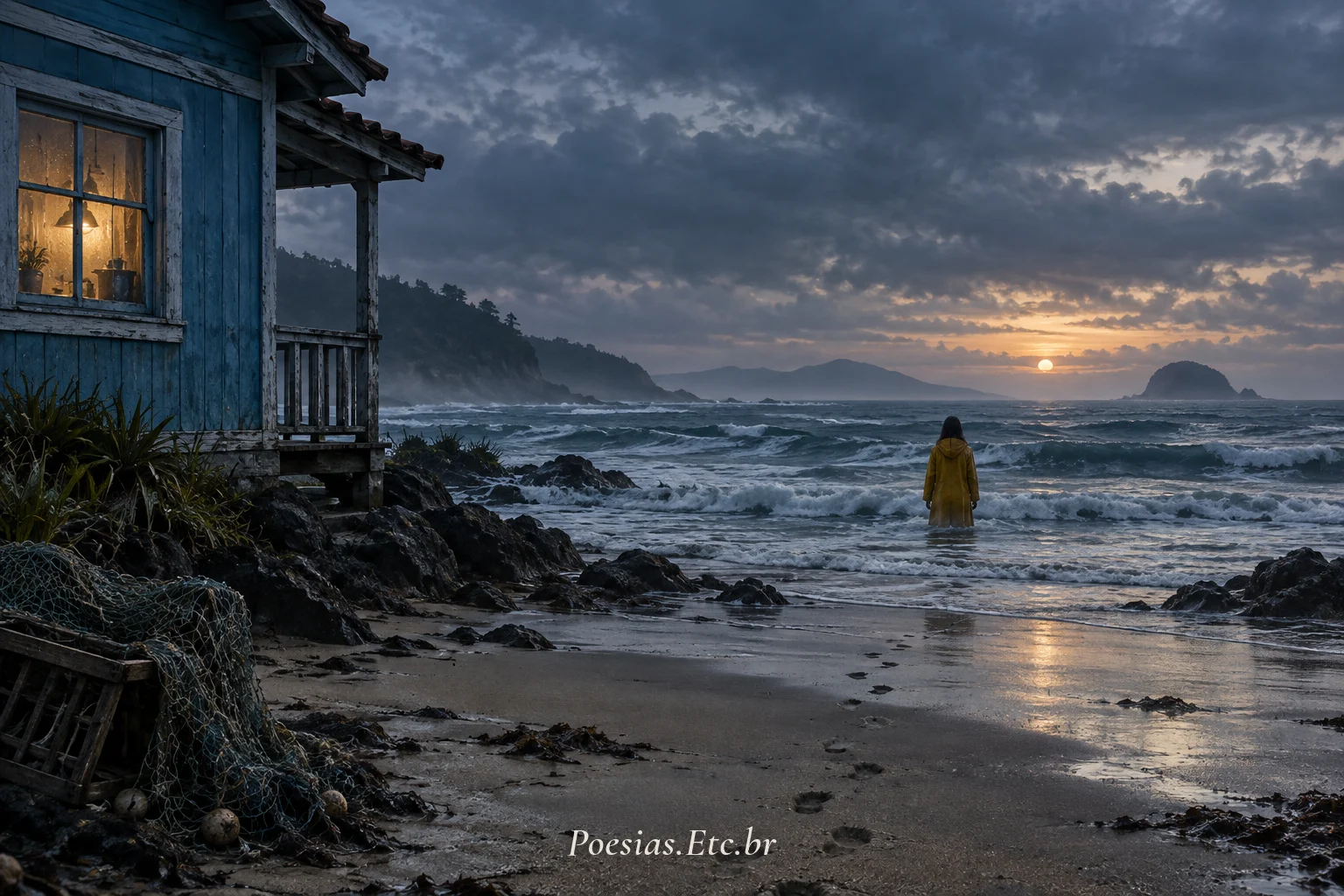
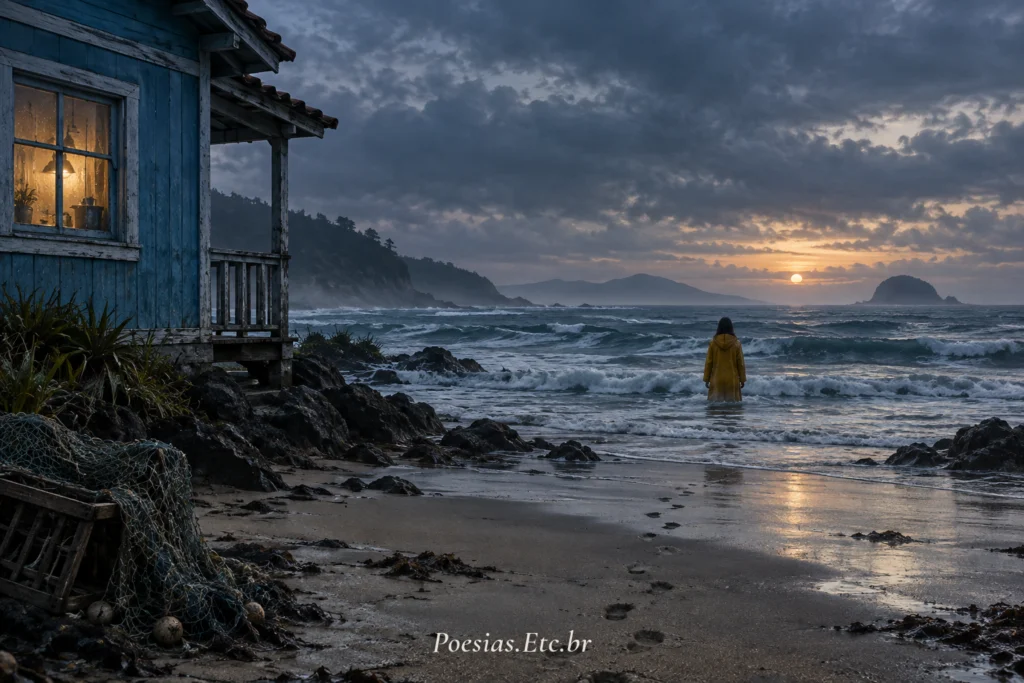
Uma mulher em pé na água, com o mar pela altura dos joelhos, de costas para a praia. Vestia um casaco de chuva amarelo. Não caminhava, não se abaixava, não procurava nada no fundo. Estava simplesmente de pé, olhando o horizonte, do jeito que a gente olha quem está demorando a chegar.
Olhei o relógio do fogão: seis e doze.
Fiquei parado com a xícara na mão, sem saber muito bem por que não abri a janela para chamar. Acho que foi a imobilidade dela. Existe uma quietude que é descanso e existe uma quietude que é espera, e a gente reconhece a diferença antes de saber explicar. Contei os minutos porque não tinha o que fazer com eles. Onze. No décimo segundo, o sol encostou na linha da água, a praia inteira ficou branca por um instante, e quando meus olhos se ajustaram não havia mais ninguém.
Anotei no caderno, na última página: “6h12. Mulher de amarelo. Onze minutos.”
Passei o resto daquela manhã procurando explicações confortáveis, e encontrei várias. Uma banhista madrugadora. Uma moradora de alguma casa depois da curva que eu ainda não tinha visto. Uma pescadora esperando o cardume subir com a claridade. Todas cabiam, todas me serviram até o café esfriar, e nenhuma explicava por que eu tinha olhado o relógio antes de olhar para ela.
No dia seguinte ela estava lá de novo. Seis e doze, como quem bate o ponto.
Capítulo 2 — Ninguém mora lá
Levei quatro dias para perguntar. Não porque eu tivesse medo da resposta, mas porque perguntar transformaria aquilo num assunto, e enquanto não fosse assunto ainda podia ser cansaço.
A padaria da vila abria às seis e meia. A mulher do balcão me atendia todo dia com a mesma frase sobre o tempo. Aproveitei uma pausa e disse, no tom mais leve que consegui, que tinha visto uma senhora tomando banho de mar bem cedo, na ponta da praia, perto da casa azul.
Ela parou de embalar o pão.
— Do lado de lá da duna não tem casa nenhuma além da sua, moço.
— Tem sim, a azul.
— A azul é a sua.
Insisti: uma mulher, casaco amarelo, na água até o joelho. Ela me olhou com uma delicadeza que eu não pedi, daquelas que a gente usa com quem está confuso, e disse que naquele trecho a correnteza puxa e que ninguém da vila entra ali, nem no verão. Depois cobrou o pão e falou do tempo.
No caminho de volta encontrei seu Nivaldo consertando rede na sombra do barracão. É o tipo de homem que responde devagar, então perguntei devagar. Disse a mesma coisa: mulher, casaco amarelo, seis e doze, ponta da praia.
Ele não riu e não me olhou com delicadeza nenhuma, o que já foi um alívio. Continuou passando a agulha pela malha por um tempo comprido e depois falou, sem levantar a cabeça:
— O senhor é o quarto que me pergunta isso.
Perguntei quem tinham sido os outros três. Ele disse que não lembrava de nome, que hóspede não fica, que a vila é pequena mas a rua da casa azul não é bem da vila. Perguntei o que ele tinha respondido para os outros três. Aí ele levantou a cabeça.
— A mesma coisa que vou responder pro senhor: não desce.
Voltei decidido a resolver aquilo com tecnologia, que é o que a gente faz quando não quer resolver de verdade. Na manhã seguinte deixei o celular apoiado na janela, filmando desde as seis. Ela veio. Eu a vi com os meus olhos, nitidamente, o amarelo aceso contra o cinza da água. Aos onze minutos ela sumiu na claridade, como sempre.
O vídeo tinha quatorze minutos de mar vazio.
Assisti seis vezes. Aumentei o brilho, congelei quadro a quadro, procurei uma mancha, um borrão, qualquer coisa. Mar, espuma, luz subindo. Foi aí que eu fiz o que devia ter feito no primeiro dia: calcei o chinelo e desci a duna até a faixa molhada, para ver o chão.
Havia pegadas.
Uma linha só, saindo da grama, atravessando a areia batida e entrando na água. Fundas, bem marcadas, de quem pisou com peso. E não havia nenhuma voltando.
Agachei e fiz o que qualquer pessoa faria: encostei meu pé ao lado de uma delas para comparar. Serviu. Serviu exatamente, do calcanhar à ponta.
Fiquei muito tempo agachado ali, com a água chegando e recuando, dizendo a mim mesmo coisas razoáveis. Que a areia molhada engana o tamanho. Que a maré apaga a volta e deixa a ida. Que eu tinha descido até a praia duas ou três vezes naquela semana, à tarde, e não lembrava exatamente onde.
Subi, escrevi tudo no caderno e sublinhei a palavra “razoável” sem saber por quê.
Naquela noite dormi de roupa. Não decidi isso; simplesmente não tirei. Acordei com o despertador às seis e havia areia entre os meus pés e o lençol, uma quantidade pequena, escura, ainda úmida. O casaco amarelo continuava no prego atrás da porta. Toquei nele. Estava molhado.
E quando abri o caderno para anotar a data, encontrei, na página anterior, uma entrada que eu não tinha escrito. Letra minha, inclinada para a direita, o mesmo “6” que eu faço com a barriga aberta. Dizia: “Ela não está esperando o mar. Está esperando eu descer.”
A data era do dia seguinte.
Capítulo 3 — A primeira página
Passei o dia inteiro montando explicações. Sonambulismo. Falta de sono acumulada, que faz o cérebro sonhar acordado. Um caderno usado por outro hóspede com letra parecida. Cada uma delas funcionava sozinha e nenhuma funcionava junto com as outras, que é o jeito honesto de dizer que eu não tinha explicação nenhuma.
Pensei em ir embora. Cheguei a colocar a mala em cima da cama e a dobrar duas camisas. Depois sentei na beirada do colchão com as camisas no colo e fiquei ali até escurecer, porque em algum lugar entre a primeira e a segunda camisa eu tinha entendido que não queria ir embora sem saber. Essa é a parte que ninguém acredita quando eu conto, e é a única parte de que eu tenho certeza absoluta.
Às seis da manhã eu já estava de pé na grama, descalço, de frente para o mar.
Ela chegou como sempre. Apareceu da minha direita, sem que eu a visse vir, e entrou na água com a naturalidade de quem repete um caminho há muito tempo. Parou na altura dos joelhos. O casaco amarelo pingava.
Eu desci.
A areia estava gelada e firme, o mar subiu pelas minhas canelas, e eu fui até ficar a três passos dela. De perto o casaco era exatamente igual ao que estava atrás da minha porta: o mesmo rasgo remendado no ombro, o mesmo punho descosturado. Chamei. Minha voz saiu mais baixa do que eu pretendia.
Ela não se virou. Levantou o braço devagar e apontou para trás de mim.
Eu olhei.
Da água, a casa azul parecia menor e mais escura, e a janela da frente estava iluminada pela luz da cozinha que eu tinha deixado acesa. Atrás do vidro havia um homem em pé. Ele segurava uma xícara. Estava completamente imóvel, olhando para o mar — não para mim, mas para o ponto onde eu estava, que é uma diferença que só existe quando você é o ponto.
Quando tornei a olhar para o lado, a mulher não estava mais lá. E o sol encostou na água, e a praia inteira ficou branca.
Subi correndo. A casa estava vazia, a porta como eu tinha deixado, a xícara na pia, seca. Sobre a mesa de fórmica, o caderno preto aberto — e não nas minhas páginas do fim, mas no começo, nas primeiras folhas que eu nunca tinha conseguido separar.
Elas não estavam estragadas. Estavam apenas coladas pelo sal, e alguma coisa naquela manhã as tinha soltado.
A letra não era a minha.
“3 de maio. 6h12. Mulher de amarelo, na água até o joelho. Onze minutos.”
“5 de maio. Perguntei na padaria. Dizem que do lado de lá da duna não tem casa nenhuma além da minha.”
“9 de maio. Filmei. O vídeo só tem mar.”
“11 de maio. As pegadas servem no meu pé.”
Fui virando as páginas com os dedos tremendo, e cada uma delas era a minha semana escrita por outra pessoa, um ano antes, na mesma ordem, com quase as mesmas palavras. A última entrada daquela letra era curta:
“Hoje eu desci até a água.”
Depois, páginas em branco. Muitas. E então, lá no fim, onde eu vinha escrevendo, as minhas próprias anotações — e a última delas, com a data de amanhã, na minha letra, que eu juro por tudo que ainda não tinha escrito:
“Hoje eu desci até a água.”
Não fui embora. Tentei explicar isso muitas vezes depois e a única frase que serve é esta: quando você entende onde está no ciclo, ir embora deixa de ser uma opção e vira apenas mais um detalhe que alguém vai anotar.
Guardei o caderno na gaveta, com as primeiras páginas para cima, coladas de novo pelo sal, do jeito que encontrei. Deixei a chave no lugar combinado. E tirei o casaco amarelo do prego atrás da porta, pela primeira vez, para ver se servia.
Serviu exatamente. Sempre serviu.
O contrato da casa azul vence na sexta. Um carro vai subir a rua com alguém que quer silêncio absoluto, e o corretor vai entregar a chave sem descer do veículo, e vai falar do sal trabalhando na madeira, e vai embora rápido demais.
Amanhã, às seis e doze, alguém vai me ver da janela.
E vai anotar a hora exata.
Twelve Past Six
Chapter 1 — The Exact Time
I rented the blue house at the end of April, when Aroeiras beach had already handed the tourists back to the mainland and kept only the wind. The listing said “absolute silence, last property on the street,” and both halves were true. Past the house there was nothing: a strip of low grass, the dune, and the sea.
The agent handed me the key without getting out of his car. He said the power went out sometimes, that the shower took a while to warm up, and that I shouldn’t be alarmed by the noise in the roof at night, because it was only the salt working on the wood. Then he drove off faster than a man who has just closed a deal usually drives.
That first night I walked the whole house with my phone’s flashlight, the way people do when they want to convince themselves they’re alone. Two bedrooms, a kitchen with a two-burner stove, a Formica table pushed up against the front window. Behind the door, on a nail, a yellow rain jacket, the fisherman kind, stiff with age. I assumed it belonged to the owner and left it there.
In the table drawer there was a black notebook. The first pages were stuck together, swollen with sea air, and I didn’t force them — I had come there to sleep, not to read a stranger’s life. I opened the notebook from the back, where the paper was still loose, and started writing my own notes there. It seemed thrifty. It even seemed like a good idea.
Before he left, I asked the agent who had stayed there last. He thought about it a little longer than the question deserved and said it was a young man, a teacher, something like that, who had rented for a month and returned the key ahead of schedule. I asked whether he’d complained about anything. The agent shrugged: “He left the key in the agreed spot and went home. Didn’t even stop by.”
I haven’t slept well in three years. That’s why I was there. The doctor had talked about routine, about natural light, about “a place where your body remembers what time the sun comes up.” So I woke early on purpose, made coffee in the dark, and sat at the Formica table waiting for the window to turn gray.
That’s how I saw her, on the third morning.
A woman standing in the water, the sea up to her knees, her back to the beach. She was wearing a yellow rain jacket. She wasn’t walking, wasn’t bending down, wasn’t looking for anything on the bottom. She was simply standing there, watching the horizon, the way you watch for someone who is taking too long to arrive.
I looked at the clock on the stove: six twelve.
I stood there with the cup in my hand, not entirely sure why I didn’t open the window and call out. I think it was her stillness. There’s a kind of stillness that is rest and a kind that is waiting, and we recognize the difference before we can explain it. I counted the minutes because I had nothing else to do with them. Eleven. On the twelfth, the sun touched the waterline, the whole beach went white for an instant, and when my eyes adjusted there was no one there.
I wrote it in the notebook, on the last page: “6:12 a.m. Woman in yellow. Eleven minutes.”
I spent the rest of that morning looking for comfortable explanations, and I found several. An early swimmer. A neighbor from some house past the bend that I hadn’t seen yet. A fisherwoman waiting for the school to rise with the light. All of them fit, all of them held up until my coffee went cold, and not one of them explained why I had looked at the clock before I looked at her.
The next day she was there again. Six twelve, punching a clock.
Chapter 2 — Nobody Lives Out There
It took me four days to ask. Not because I was afraid of the answer, but because asking would turn it into a subject, and as long as it wasn’t a subject it could still be exhaustion.
The village bakery opened at six thirty. The woman behind the counter served me every day with the same sentence about the weather. I waited for a pause and said, as lightly as I could manage, that I’d seen a woman swimming very early, out at the end of the beach, near the blue house.
She stopped bagging the bread.
“There’s no house on the far side of the dune but yours, sir.”
“There is. The blue one.”
“The blue one is yours.”
I pressed: a woman, yellow jacket, in the water up to her knees. She looked at me with a gentleness I hadn’t asked for, the kind you use on someone who’s confused, and said the current pulls hard along that stretch and nobody from the village goes in there, not even in summer. Then she rang up the bread and talked about the weather.
On the way back I ran into Mr. Nivaldo mending a net in the shade of the boat shed. He’s the sort of man who answers slowly, so I asked slowly. I said the same thing: woman, yellow jacket, six twelve, the end of the beach.
He didn’t laugh and he didn’t look at me gently, which was already a relief. He kept running the needle through the mesh for a long stretch and then spoke without lifting his head.
“You’re the fourth one to ask me that.”
I asked who the other three had been. He said he didn’t remember names, that renters don’t stay, that the village is small but the blue house’s street isn’t really the village. I asked what he’d told the other three. That’s when he raised his head.
“Same thing I’m telling you: don’t go down.”
I came back determined to settle it with technology, which is what we do when we don’t actually want to settle anything. The next morning I propped my phone on the windowsill, recording from six o’clock on. She came. I saw her with my own eyes, clearly, that yellow lit against the gray water. At the eleventh minute she dissolved into the brightness, the way she always did.
The video held fourteen minutes of empty sea.
I watched it six times. I raised the brightness, froze it frame by frame, looked for a smudge, a blur, anything. Sea, foam, light climbing. That’s when I did what I should have done on the first day: I put on my sandals and went down the dune to the wet strip, to look at the ground.
There were footprints.
A single line, leaving the grass, crossing the packed sand and going into the water. Deep, well pressed, the tracks of someone walking with weight. And not one of them coming back.
I crouched and did what anyone would do: I set my foot beside one of them to compare. It fit. It fit exactly, heel to toe.
I stayed crouched there a long time, the water reaching and retreating, telling myself reasonable things. That wet sand distorts size. That the tide erases the way back and leaves the way in. That I’d gone down to the beach two or three times that week, in the afternoon, and couldn’t remember exactly where.
I went up, wrote it all in the notebook, and underlined the word “reasonable” without knowing why.
That night I slept in my clothes. I didn’t decide to; I simply didn’t take them off. The alarm woke me at six and there was sand between my feet and the sheet, a small amount, dark, still damp. The yellow jacket was still on its nail behind the door. I touched it. It was wet.
And when I opened the notebook to write the date, I found, on the previous page, an entry I hadn’t written. My handwriting, slanting right, the same “6” I make with the belly left open. It said: “She isn’t waiting for the sea. She’s waiting for me to come down.”
It was dated the following day.
Chapter 3 — The First Page
I spent the whole day assembling explanations. Sleepwalking. Accumulated sleep debt, which makes the brain dream while awake. A notebook used by an earlier guest with similar handwriting. Each one worked on its own and none of them worked alongside the others, which is the honest way of saying I had no explanation at all.
I thought about leaving. I got as far as putting the suitcase on the bed and folding two shirts. Then I sat on the edge of the mattress with the shirts in my lap and stayed there until dark, because somewhere between the first shirt and the second I had understood that I didn’t want to leave without knowing. That’s the part nobody believes when I tell it, and it’s the only part I’m absolutely sure of.
At six in the morning I was already standing on the grass, barefoot, facing the sea.
She arrived the way she always did. She appeared on my right, without my seeing her come, and walked into the water with the ease of someone repeating a route she’s walked for years. She stopped at knee height. The yellow jacket was dripping.
I went down.
The sand was cold and firm, the sea climbed my shins, and I kept going until I was three steps from her. Up close the jacket was exactly like the one behind my door: the same patched tear at the shoulder, the same unstitched cuff. I called out. My voice came out lower than I meant it to.
She didn’t turn. She raised her arm slowly and pointed behind me.
I looked.
From the water, the blue house looked smaller and darker, and the front window was lit by the kitchen light I’d left on. Behind the glass a man was standing. He was holding a cup. He was completely still, looking at the sea — not at me, but at the spot where I was, which is a difference that only exists when you are the spot.
When I looked back to my side, the woman was gone. And the sun touched the water, and the whole beach went white.
I ran up. The house was empty, the door exactly as I’d left it, the cup in the sink, dry. On the Formica table, the black notebook lay open — and not at my pages in the back, but at the beginning, at the first sheets I had never managed to separate.
They weren’t ruined. They were only glued shut by salt, and something that morning had loosened them.
The handwriting wasn’t mine.
“May 3. 6:12 a.m. Woman in yellow, in the water up to her knees. Eleven minutes.”
“May 5. Asked at the bakery. They say there’s no house on the far side of the dune but mine.”
“May 9. Filmed it. The video is only sea.”
“May 11. The footprints fit my foot.”
I turned the pages with shaking fingers, and every one of them was my week written by someone else, a year earlier, in the same order, in almost the same words. The last entry in that hand was short:
“Today I went down to the water.”
After that, blank pages. Many. And then, at the far end, where I’d been writing, my own notes — and the last of them, dated tomorrow, in my handwriting, which I swear on everything I had not yet written:
“Today I went down to the water.”
I didn’t leave. I’ve tried to explain this many times since, and the only sentence that works is this one: once you understand where you are in the cycle, leaving stops being an option and becomes just one more detail for someone to write down.
I put the notebook back in the drawer, first pages up, sealed again by the salt, the way I found it. I left the key in the agreed spot. And I took the yellow jacket off the nail behind the door, for the first time, to see whether it fit.
It fit exactly. It always had.
The lease on the blue house ends Friday. A car will come up the street carrying someone who wants absolute silence, and the agent will hand over the key without getting out, and he’ll mention the salt working on the wood, and he’ll drive off too fast.
Tomorrow, at six twelve, someone will see me from the window.
And they’ll write down the exact time.
O que você achou?
Escreva o que este texto provocou em você. Leio tudo o que chega.