Aos sessenta e três anos, um homem sobe até a crista para ver o sol nascer e encontra uma porta de madeira no meio do lago salgado.
Elias Ward fez sessenta e três anos em março e não contou para ninguém. Não havia mais ninguém no rancho para contar. Clara estava morta havia oito anos naquele agosto, e o filho, Daniel, morava mil e quinhentos quilômetros a leste, numa cidade que Elias tinha visitado duas vezes, e das duas foi embora antes da hora.
O rancho tinha encolhido. Não a escritura — a escritura dizia os mesmos quatrocentos e cinquenta hectares que dizia quando o pai dele assinou. Mas Elias não cavalgava até a divisa leste desde a primavera em que fez sessenta, e as trilhas de gado daquele lado estavam fechando de capim, do jeito que uma cicatriz vai clareando até sumir. Em algumas manhãs ele achava que a terra o estava esquecendo de propósito. Com educação. Devolvendo-o aos poucos.
Mesmo assim levantava antes da luz. Café, o chapéu marrom, o colete que tinha ficado da cor de uma sela, e ia até o curral, onde Mercy esperava com aquele desprezo paciente que as éguas velhas têm pelos homens que falam sozinhos.
Ele dizia a si mesmo que ia conferir a cerca. Conferia a mesma cerca havia dois anos. O que fazia de verdade, e ele sabia e não dizia, era procurar um motivo para fazer de novo no dia seguinte.
* * *
A manhã em que aconteceu foi catorze de agosto, e ele tinha subido a crista acima do lago salgado porque a luz de lá valia a subida. Chegou no alto com o sol já rompendo, laranja deitado sobre o sal, e puxou Mercy com tanta força que ela bufou para ele.
As estrelas não tinham apagado.
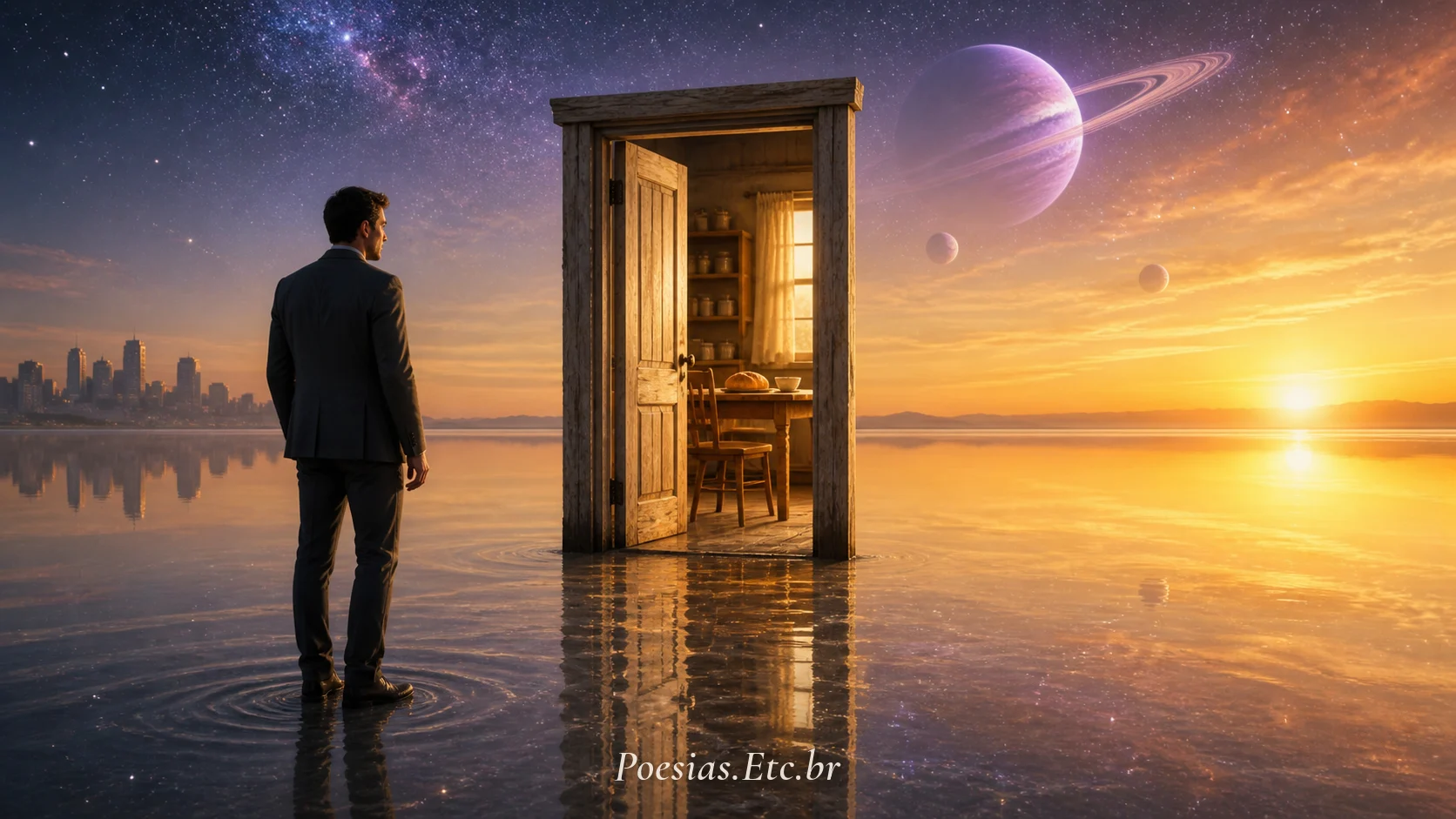
Deviam ter apagado. Era manhã cheia, aquela luz em que se lê uma marca de ferro a distância, e as estrelas continuavam lá em cima, grossas feito cascalho. Onde devia estar a lua havia um planeta — violeta, enorme, perto o bastante para ele ver uma faixa de prata em volta, como arame enrolado num carretel. Duas luas menores pairavam ao norte, e uma delas se movia à vista.
Elias tirou o chapéu. Esfregou os olhos com o polegar e o nó do dedo, forte o suficiente para ver vermelho, e olhou de novo. Nada mudou.
— Bom — disse. — Ou eu morri, ou alguém finalmente perdeu o fio da meada.
Mercy baixou a cabeça e começou a comer o capim.
Então o sol parou.
Ele não percebeu o instante. Percebeu depois, do jeito que a gente só nota um relógio quando ele para. O sol ficou pela metade fora d’água e ali permaneceu, e a estrada de luz sobre o lago não se mexeu mais, e o vento que subia a grota se apagou como um lampião. O capim ficou imóvel. Nenhum inseto. Nenhuma gaivota sobre a água. Ele não ouvia Mercy respirar, e ela estava a dois passos, e dava para ver as costelas dela indo e voltando.
No fim daquela estrada de luz, lá onde o lago devia estar vazio, havia uma porta.
Só uma porta. Um batente de madeira em pé na parte rasa, cinza de tempo, um pouco fora de prumo. Nenhuma parede em volta. E o que havia do outro lado não era o outro lado do lago. Era preto, e tinha estrelas, e não eram as mesmas estrelas.
Elias tinha passado a vida inteira sem acreditar em nada que não se consertasse com arame, madeira, paciência e a chave certa. Amarrou a rédea de Mercy num cedro, com duas voltas, do jeito que se amarra quando se pretende voltar.
Depois desceu até a água e pôs a bota nela, e ela aguentou.
O lago segurou o peso dele como um assoalho. Cada passo mandava um anel de ouro correndo pela superfície. No meio do caminho ele olhou para trás e viu a égua debaixo daquele céu impossível, mastigando, um bicho comum no meio de uma manhã que tinha se desmanchado, e isso o firmou mais do que qualquer reza que ele conseguisse lembrar.
Atravessou.
* * *
Saiu de pé na cozinha da mãe.
O fogão estava aceso. Havia farinha na mesa e farinha no ar, suspensa na luz que entrava pela janela sobre a pia — a janela que um tornado levou em 1974, vidro, caixilho e um pedaço da parede junto. A mãe estava em pé à mesa, com as mangas empurradas acima do cotovelo, sovando um pão. O pai sentado perto do fogão, com uma bota no colo e um canivete, raspando barro do solado.
Eram jovens. Mais jovens do que Daniel era agora.
No chão, perto do caixote de lenha, um menino tinha construído um rancho de blocos e discutia baixinho consigo mesmo sobre onde ficava a porteira. Tinha olhos cinzentos. Tinha o rosto inteiro de Elias e nenhuma das suas milhas.
A mãe ergueu os olhos e soprou uma mecha de cabelo da testa.
— Você está atrasado — disse.
Elias não conseguiu tirar nada da garganta.
O pai inclinou o canivete na direção da cadeira vazia. — Senta antes de cair.
— Vocês são… — ele teve que parar e começar de novo. — Vocês são fantasmas?
— Isso mudaria o jeito de você sentar? — disse a mãe.
Ele sentou. Ela cortou a ponta de um pão que tinha saído do forno havia uma hora e cinquenta anos e pôs na frente dele, e cheirava a trigo, fumaça, manteiga e ter nove anos e não ter medo de nada.
— Eu fiquei pensando em vocês dois — disse. — Para onde foram. Se tinha alguma coisa depois.
O pai voltou para a bota. — Você sempre quis a resposta antes de terminar o serviço.
— Que serviço?
— O de viver — disse a mãe, sem levantar a cabeça.
Perto do caixote de lenha, o menino pôs uma vaca de madeira dentro da cerca que tinha feito e mudou a porteira de lugar outra vez.
Elias ficou olhando um tempo. — Eu achava que esta cozinha era o mundo inteiro.
— Para ele, é — disse ela.
— E quando a gente descobre que não é?
— Aí o mundo fica maior. — Ela virou a massa. — Ninguém prometeu que fica mais gentil.
O cômodo começou a ir embora. A farinha subiu da mesa e ficou parada no ar como o começo de uma poeira, e a luz daquela janela ficou fina, e as mãos do pai já eram menos que mãos.
A mãe esticou o braço e pôs a palma enfarinhada sobre a mão dele, e estava quente, e era dela.
— Você vive me perguntando para onde foram os mortos — disse. — Pergunta onde estão os vivos.
* * *
A cozinha sumiu e ele estava numa esquina, com o barulho de uma cidade vindo de todos os lados.
Céu cinzento, ou céu nenhum — alguma coisa da cor de lençol mal lavado, e torres subindo até deixarem de ser visíveis. As pessoas passavam por ele de cabeça baixa sobre as telas. Máquinas corriam pela rua fazendo um barulho de respiração.
Do outro lado da avenida, pela janela de um café, ele viu Daniel.
Quarenta anos. Terno escuro, sem gravata, colarinho aberto. Seu menino, que dormia no paiol e tinha que ser carregado para dentro, sentado sozinho numa sala cheia de gente com a cara da cor do papel.
Elias atravessou sem olhar. Nada bateu nele.
— Daniel.
O filho não virou. Elias pôs a mão no ombro dele e a mão atravessou, e ele ficou ali um segundo segurando nada, e então sentou na cadeira vazia.
Na tela à frente de Daniel havia uma mensagem pela metade.
*Pai, eu sei que fico dizendo que vou aí. Não sei por que é tão difícil*
Daniel segurou a tecla e ficou vendo a frase ser comida de trás para frente.
Uma mulher pôs uma xícara do outro lado e sentou, o crachá ainda no pescoço. — Liga para ele.
— Vou ligar.
— Você diz isso desde junho.
Daniel olhou pela janela por um tempo longo. — Quando eu volto, está tudo lá. A cadeira da minha mãe na mesa. O galpão caindo. Todas as versões de mim que aquele homem esperava.
— E seu pai?
— Ele olha para mim como se entendesse. — Daniel girou a xícara um quarto de volta. — Essa é a parte que eu não aguento.
Elias ficou sentado com as mãos nos joelhos.
Havia oito anos ele carregava uma explicação no bolso, feito pedra: a cidade tinha deixado o filho pequeno, ocupado e egoísta, e um dia o menino cairia em si. Estava tão satisfeito com ela. Tinha repetido aquilo para homens na loja de ração.
A verdade estava sentada à frente dele o tempo todo, e era esta: Daniel não estava fugindo do pai. Estava fugindo do homem que temia não ter conseguido ser, e o rosto do pai era onde esse homem morava.
O café virou chuva, e a chuva virou nada.
* * *
Ele estava numa planície que se estendia lisa em toda direção sob três luas, e a planície estava cheia de portas.
Milhares delas. Em pé, soltas na terra, sem nada segurando, cada uma aberta num pedaço de algum lugar.
Pela primeira, Clara estava velha. A doença tinha virado no segundo ano, do jeito que vira para outras pessoas, e ela tinha setenta anos, cabelo grisalho, de joelhos no canteiro de tomates, dizendo que ele tinha amarrado errado. Tinha mesmo. Sempre amarrava.
Por outra, eles tinham vendido o rancho e ido embora. Ela estava em pé num muro de pedra sobre uma água estrangeira e verde, com o cabelo voando de lado, rindo dele debaixo de um guarda-sol vermelho.
Por uma terceira, ele nunca a tinha conhecido. Aquele Elias tinha dinheiro e um chapéu em que nunca tinha chovido, e estava numa sala cheia de gente que o admirava, e era a coisa mais sozinha que Elias já tinha visto.
Ele foi descendo a fileira.
Numa, Daniel tinha ficado no rancho e o odiava por isso, em silêncio, durante trinta anos.
Numa, Elias tinha morrido aos quarenta e Clara criou o menino sozinha e fez melhor do que os dois juntos.
Numa não havia gente nenhuma. Só cavalos num vale verde, atravessando água, sem nome em cima deles, sem uma cerca à vista e sem ninguém para dizer o que aquilo significava.
— Qual é a de verdade?
O homem tinha chegado ao lado dele. Casaco preto, mãos soltas. O rosto não parava quieto — toda vez que Elias olhava de frente, era o rosto de outra pessoa, e nenhum era estranho, e nenhum era ninguém.
— A que eu vivi — disse Elias.
— Por que essa?
— Porque eu lembro dela.
— Você lembra de sonhos. Lembra de coisas que te contaram. Esqueceu a maior parte da sua própria vida.
Elias olhou para as portas indo até a beirada do mundo.
— Então é a que deixou marca.
— A dor, como prova.
— Não só a dor. — Ele estava pensando em Clara rindo dele em cima daquele muro no outro lugar, e numa mão pequena dentro da dele descendo a rampa de embarque, e na chuva no telhado do galpão no ano em que não tiveram nada, e em pão. — Amor também deixa.
O homem de casaco começou a andar entre as portas, e Elias andou junto.
— Você veio aqui atrás do que tudo isso significa. Então escolhe uma. Qualquer uma. Fica. Escolhe com cuidado suficiente e não sobra arrependimento nenhum em você.
Tinham parado diante da primeira porta. Clara na varanda no fim da tarde, com um livro aberto no joelho, e a luz entrando por baixo do beiral do jeito que entra àquela hora, e a outra cadeira vazia do lado.
As botas de Elias andaram sem pedir licença.
Ela levantou a cabeça como quem escuta uma caminhonete na estrada. O cabelo era prateado. Os olhos eram os mesmos.
— Elias?
A mão dele já estava erguida.
E ele pensou no filho naquele café, escrevendo e apagando as mesmas onze palavras.
— Se eu atravessar aquela porta — disse —, aquela é a Clara?
— É uma Clara.
— Não a minha.
— Qual é a diferença?
— A minha morreu.
Havia oito anos ele não dizia daquele jeito. Dizia partiu, foi para casa, eu a perdi, todos os paninhos que a gente põe por cima. Ficou ali parado e deixou aquilo ser o que era.
Ela morreu.
E lhe ocorreu, de pé naquela planície com a mão no ar, que a morte dela não era um erro na história que um mundo melhor teria corrigido. Estava na história. Era o mesmo fio dos tomates, da amarração malfeita e do ano de chuva. Se ele pegasse um mundo em que ela não morria, estava devolvendo aquele em que ela o tinha amado.
Baixou a mão.
A porta se fechou sozinha e Clara foi junto.
— Você escolheria o sofrimento — disse o homem.
— Eu escolho o que aconteceu.
— Por quê?
— Porque amor que precisa de um mundo melhor do que aquele em que aconteceu não é amor. — Elias deu de ombros. — É troca.
* * *
A planície se desfez.
As portas caíram uma depois da outra, a fileira inteira, e não fizeram barulho ao chegar no chão, e onde elas estavam apareceu a coisa toda: galáxias girando devagar como poeira num facho de luz, estrelas acendendo, mundos queimando até o fim, tudo ao mesmo tempo e nada com pressa.
— Olha para isso — disse o homem. — Você queria sentido. Está vendo algum?
Elias olhou.
Viu estrelas se queimando até virar o ferro que corria no sangue dele. Viu água chegando num planeta que ninguém nunca daria nome. Viu uma cidade levantar um muro, se declarar permanente e ir embora debaixo da areia sem sobrar quem escrevesse. Viu uma mulher numa guerra passar um bebê por cima de uma cerca. Viu quatro homens tirarem um carro de cima de um desconhecido e depois discutirem quem tinha feito mais força. Viu uma enfermeira sentar ao lado de um homem sem família e segurar a mão dele por quarenta minutos porque era o que havia. Viu gente sendo cruel de propósito, e gente sendo cruel sem perceber, que é pior, e viu mais disso do que queria.
— Não — disse. — Não estou vendo sentido nenhum.
O rosto ficou liso. — Então você fracassou.
— Pode ser.
Abaixo deles uma galáxia se apagou como brasa.
— Mas estou vendo gente fazendo sentido — disse Elias.
— Fazendo. Então é invenção.
— Cerca também é.
— Cerca não é verdade.
— Diga isso para o gado. — Elias enfiou os polegares no cinto. — Cerca é uma coisa que um homem decidiu, do nada, com arame. Ainda assim segura uma novilha à meia-noite na chuva. Promessa é invenção. Seu nome é invenção. Tem gente que morreu cumprindo os dois.
— Então a vida significa o que o homem decidir que significa.
— Não. Isso seria fácil, e nada aqui foi fácil.
Ele mexeu na questão do jeito que teria mexido numa enfardadeira que não amarrava — sem perguntar o que ela devia fazer, olhando o que ela fazia.
— Um homem pode decidir que crueldade significa alguma coisa. Isso não faz valer nada. Tem que aguentar quando encosta em outra pessoa. — Ele olhou para tudo aquilo. — Talvez seja aí. Não dentro de um homem. Entre dois. Na parte em que o que eu faço cai em cima de alguém e vira a vida dessa pessoa.
Nada se moveu lá fora. Ele continuou assim mesmo.
— Eu não pude ficar com a Clara. Mas ela não morreu sozinha, e isso importava para ela, então importou — é todo o meu argumento. E quando Daniel foi embora eu chamei aquilo de fraqueza, e ele teve que ir viver num mundo onde o pai dele disse isso. Isso também importou.
— E o universo — disse o homem. — Se importa?
— Não sei.
— Existe sentido se ele não se importa?
Elias pôs o chapéu de volta.
— A água não se importa se o homem tem sede. Ele bebe e vive.
O rosto dentro do casaco preto fez uma coisa que ainda não tinha feito. Ficou parado.
* * *
Tudo se dobrou e ele estava sentado num deserto sob um céu preto, com os planetas de volta lá em cima, enormes e calados, e havia uma fogueira dentro de um círculo de pedras.
Clara estava do outro lado do fogo, do jeito que tinha ficado no último ano. Magra. Cansada. As mãos frias mesmo em agosto.
Ele não perguntou se ela era real. Tinha terminado com essa pergunta.
Sentou ao lado dela.
— Você demorou — disse ela.
— Eu estava procurando o sentido da vida.
— E?
— Não achei.
— Isso é bem a sua cara.
Ele riu, e saiu errado, e ela deixou.
Clara olhou para o fogo. — Você decidiu que a morte dela apagou. Tudo.
— Em alguns dias.
— Uma música não significa nada depois que acaba?
— Não.
— A manhã não significa nada por causa da noite que vem depois?
— Não.
Ela pegou a mão dele. Estava quente, e ele sabia exatamente quanto aquilo valia, e pegou assim mesmo.
— Nada precisa durar para ter sido de verdade — disse ela. — Só precisa ter acontecido.
Os olhos dele se encheram. — Estou com saudade.
— Eu sei.
— Não quero voltar e te deixar de novo.
— Você não está me deixando. — Ela apontou com o queixo para o horizonte, que tinha começado a clarear. — Você está voltando para a parte da gente que ainda falta fazer.
— Daniel.
— Daniel.
— E se for tarde demais?
— Sempre é tarde demais para alguma coisa — disse Clara. — Por isso existe agora.
A fogueira apagou.
* * *
Ele estava diante da porta cinzenta com o lago do outro lado, e o sol ainda emperrado pela metade fora d’água, e Mercy na barranca, debaixo do cedro, com a anca descansada.
O homem de casaco preto estava ao lado dele.
— O que você vai fazer com a sua resposta?
— Parar de tratar isso como pergunta.
— E tratar como o quê?
Elias pensou mais tempo do que precisava.
— Como uma dívida.
Atravessou.
O sol se soltou e começou a subir. O vento voltou pela grota, passou pelo capim e seguiu adiante. As gaivotas recomeçaram sobre a água. Mercy levantou a cabeça e bufou.
Os planetas foram sumindo, mas não de todo — por um ou dois minutos ele ainda conseguia achá-los, pálidos como marca de dedo na manhã, e depois não conseguiu mais.
Voltou para casa.
* * *
Ficou um tempo longo na cozinha com a mão em cima do telefone.
Essa é a parte de que ninguém avisa. Ele tinha atravessado um lago a pé. Tinha dito a uma coisa de rosto trocado, numa planície de portas, que ela estava errada sobre cercas. E ali estava, suando por causa de sete números, porque morto não pode te recusar e vivo pode.
Discou.
Tocou quatro vezes.
— Pai?
— Bom dia.
— Está tudo bem? Aconteceu…
— Não aconteceu nada. Ninguém morreu.
Aí nenhum dos dois falou, e oito anos ficaram de pé no meio, olhando para os dois.
Elias tomou fôlego.
— Eu te devo um pedido de desculpa.
Daniel não disse nada.
— Eu decidi, faz tempo, que você ter ido embora significava que você não ligava para este lugar. Nem para mim. Nunca me passou pela cabeça perguntar quanto te custou ir.
— Pai…
— Me deixa terminar, senão não sai. Passei oito anos esperando você voltar para casa e nenhuma hora fazendo daqui um lugar em que dava para voltar. Isso é meu. Isso fui eu.
Ele ouviu o filho puxar o ar, e o ar quebrou no meio.
— Não sei o que dizer.
— Você não precisa dizer nada hoje.
— Você está doente? — perguntou Daniel. — É isso?
Elias riu, a primeira vez em muito tempo. — Não mais do que o normal.
— Então o que aconteceu?
Ele olhou pela janela sobre a pia, para o curral, a égua e os quatrocentos e cinquenta hectares.
— Eu vi o sol nascer.
— Só isso?
— Não — disse Elias. — Mas essa é a parte em que você acredita.
Aí veio um som na linha que Elias não ouvia desde que o menino tinha doze anos, e ele não fingiu que era chiado.
— Estou com saudade da mãe — disse Daniel.
— Eu também. Todo dia, e duas vezes no domingo.
— De você também.
— Estou bem aqui.
Falaram até a sombra do galpão dar a volta e chegar na porta. Nada foi consertado. Oito anos não caem porque um homem atravessou uma porta dentro de um lago. Mas Daniel disse que ia olhar o calendário, e falou sério o suficiente para dizer um mês em voz alta, e Elias anotou no bloquinho ao lado do telefone e não comentou mais nada, o que exigiu algum esforço.
* * *
Naquela noite ele subiu até a crista sozinho.
O céu era o céu. Uma lua, fina, subindo. Nenhum planeta violeta, nenhum anel, nenhuma estrada de fogo sobre a água e nenhuma porta em pé dentro dela. O sol desceu e pareceu, como sempre parece, que estava se apagando.
Ele viu o sol ir embora sem perguntar se voltaria. Tinha parado de precisar saber disso. Saber nunca foi o que o segurou em cima do cavalo.
O universo provavelmente não tem nada a dizer para ninguém. É calado, é enorme, e não foi construído pensando nele. Mas dentro de todo esse silêncio um homem pode responder a outro homem. Uma mão pode achar outra mão. E uma promessa, que é uma coisa inventada do ar, pode fazer um lugar pequeno o bastante para caber alguém dentro.
Elias tirou o chapéu enquanto a última luz ia embora.
Não descobriu por que nada disso está aqui.
Descobriu onde o sentido se guarda — no chão entre uma pessoa e outra, que não é longe, e é o terreno mais duro que ele já atravessou.
The Distance Between Worlds
Elias Ward turned sixty-three in March and didn’t tell anyone. There was no one left on the place to tell. Clara had been dead eight years that August, and his son Daniel lived nine hundred miles east in a city Elias had visited twice, both times leaving early.
The ranch had gotten smaller. Not the deed — the deed said the same eleven hundred acres it had said when his father signed it. But Elias hadn’t ridden the east boundary since the spring he turned sixty, and the cattle trails out that way were closing over with cheatgrass, the way a scar goes pale and then goes missing. Some mornings he thought the land was forgetting him on purpose. Being polite about it. Giving him back by inches.
Still he got up before light. Coffee, the brown hat, the vest that had gone the color of a saddle, and out to the corral where Mercy stood waiting with that patient contempt old mares have for men who talk to themselves.
He told himself he was checking fence. He’d been checking the same fence for two years. What he was actually doing, he knew and didn’t say, was looking for a reason to do it again tomorrow.
* * *
The morning it happened was the fourteenth of August, and he’d ridden up the ridge above the salt lake because the light there was worth the climb. He came over the top with the sun already breaking, orange laid flat across the alkali, and he pulled Mercy up so hard she snorted at him.
The stars hadn’t gone out.
They should have. It was full morning, the kind of light you could read a brand by, and the stars sat up there anyway, thick as gravel. Where the moon ought to have been there was a planet — violet, enormous, close enough that he could see a band of silver laid around it like wire on a spool. Two smaller moons hung north of it, one of them plainly moving.
Elias took his hat off. He rubbed his eyes with his thumb and knuckle, hard enough to see red, and looked again. Nothing changed.
“Well,” he said. “Either I’m dead, or somebody’s finally lost the thread of this thing.”
Mercy dropped her head and started in on the grass.
Then the sun stopped.
He didn’t notice the instant of it. He noticed after, the way you notice a clock only when it quits. The sun sat half out of the water and stayed there, and its road of light lay across the lake without moving, and the wind that had been coming up the draw went out like a lamp. The grass stood still. No insects. No gulls off the water. He couldn’t hear Mercy breathing, and she was six feet from him, and he could see her ribs going.
At the far end of that road of light, out where the lake should have been empty, there was a door.
Just a door. A wooden frame standing up out of the shallows, weathered gray, a little out of plumb. No walls anywhere near it. What was on the other side of it was not the other side of the lake. It was black, and it had stars in it, and they weren’t the same stars.
Elias had spent his whole life not believing in anything that couldn’t be fixed with wire, wood, patience, or the right wrench. He looped Mercy’s rein around a cedar, twice, the way you do when you intend to come back.
Then he walked down to the water and put his boot on it, and it held.
The lake took his weight like a floor. Every step sent a ring of gold out across it. Halfway there he looked back and saw the mare standing under that impossible sky, chewing, one ordinary animal in the middle of a morning that had come apart, and it steadied him more than any prayer he could have come up with.
He stepped through.
* * *
He came out standing in his mother’s kitchen.
The stove was going. There was flour on the table and flour in the air, hanging in the light from the window over the sink — the window a tornado had taken out in 1974, glass and frame and part of the wall with it. His mother stood at the table with her sleeves shoved up past her elbows, working a loaf. His father sat by the stove with a boot in his lap and a knife, scraping mud off the welt.
They were young. Younger than Daniel was now.
On the floor by the woodbox, a boy had built a ranch out of blocks, and was arguing quietly with himself about where the gate should go. He had gray eyes. He had every bit of Elias’s face and none of the mileage.
His mother looked up and blew a strand of hair off her forehead.
“You’re late,” she said.
Elias couldn’t get anything out.
His father tipped the knife toward the empty chair. “Sit down before you fall down.”
“Are you—” He had to stop and start over. “Are you ghosts?”
“Would it change how you sit?” his mother said.
He sat. She cut the heel off a loaf that had come out of the oven an hour and fifty years ago and put it in front of him, and it smelled like wheat and smoke and butter and being nine years old and not afraid of anything.
“I’ve wondered about you two,” he said. “Where you went. Whether there was any of it after.”
His father went back to the boot. “You always did want the answer before you finished the job.”
“What job?”
“The living,” his mother said, without looking up.
Over by the woodbox the boy set a wooden cow inside the fence he’d built and moved the gate again.
Elias watched him a while. “I used to think this kitchen was the whole world.”
“For him it is,” she said.
“And when you find out it isn’t?”
“Then the world gets bigger.” She turned the dough. “Nobody promised it gets kinder.”
The room started to go. The flour lifted off the table and hung there like the first of a dust storm, and the light from that window went thin, and his father’s hands were already less than hands.
His mother reached across and put her floured palm over the back of Elias’s hand, and it was warm, and it was hers.
“You keep asking me where the dead went,” she said. “Ask where the living are.”
* * *
The kitchen was gone and he was on a street corner with the noise of a city coming at him from every side.
Gray sky, or no sky — something the color of an unwashed sheet, and towers going up into it until they quit being visible. People streamed around him with their heads down over their screens. Machines went by on the street making a noise like breath.
Across the avenue, through the window of a café, he saw Daniel.
Forty years old. Dark suit, no tie, the collar open. His boy, who used to fall asleep in the haybarn and have to be carried in, sitting alone in a room full of people with his face the color of paper.
Elias went across without looking. Nothing hit him.
“Daniel.”
His son didn’t turn. Elias put a hand on his shoulder and his hand went through it, and he stood there a second holding nothing, and then he sat down in the empty chair instead.
On the screen in front of Daniel there was a message half written.
*Dad, I know I keep saying I’ll come out. I don’t know why it’s so hard to*
Daniel held the key down and watched it eat the sentence backward.
A woman put a cup down across from him and sat, lanyard still around her neck. “Call him.”
“I will.”
“You’ve been saying that since June.”
Daniel looked out the window a long time. “When I go back, it’s all still there. Mom’s chair at the table. The barn falling in. Every version of me that guy was hoping for.”
“And your dad?”
“He looks at me like he understands.” Daniel turned the cup a quarter turn. “That’s the part I can’t take.”
Elias sat with his hands on his knees.
For eight years he’d carried an explanation around like a stone in his pocket: the city had made his son small and busy and selfish, and one day the boy would come to his senses. He’d been so satisfied with it. He’d repeated it to men at the feed store.
The truth had been sitting across a table from him the whole time, and it was this: Daniel wasn’t staying away from his father. He was staying away from the man he was afraid he’d failed to become, and his father’s face was where that man lived.
The café went to rain, and the rain went to nothing.
* * *
He stood on a plain that ran out flat in every direction under three moons, and the plain was full of doors.
Thousands of them. Standing loose in the dirt with nothing holding them up, each one open on a piece of somewhere.
Through the first, Clara was old. The illness had turned around in the second year, the way it does for other people, and she was seventy and gray and on her knees in the tomatoes, telling him he’d staked them wrong. He had. He always did.
Through another they’d sold the place after all and gone. She was standing on a stone wall over some green foreign water with her hair blowing sideways, laughing at him under a red umbrella.
Through a third he’d never met her. That Elias had money and a hat that had never been rained on, and he was standing in a room full of people who admired him, and he was the loneliest thing Elias had ever seen.
He went down the row.
In one, Daniel had stayed on the ranch and hated him for it, quietly, for thirty years.
In one, Elias had died at forty and Clara had raised the boy alone and done it better than the two of them together.
In one there were no people at all. Just horses in a green valley, crossing water, with no names on them and no fence in sight and nobody to say what any of it meant.
“Which one’s the real one?”
The man had come up beside him. Black coat, hands loose. His face wouldn’t hold still — every time Elias looked square at it, it was somebody else’s, and none of them were strangers, and none of them were anybody.
“The one I lived,” Elias said.
“Why that one?”
“Because I remember it.”
“You remember dreams. You remember things people told you happened. You’ve forgotten most of your own life.”
Elias looked out at the doors going off to the edge of the world.
“Then it’s the one that left marks.”
“Pain, as proof.”
“Not only pain.” He was thinking about Clara laughing at him from the wall in that other place, and about a small hand in his going down the loading chute, and rain on the barn roof the year they had nothing, and bread. “Love leaves them too.”
The man in the coat started walking between the doors, and Elias walked with him.
“You came out here looking for what it all means. So take one. Any of them. Stay. Pick carefully enough and there’s no regret left in you anywhere.”
They had stopped in front of the first door. Clara on the porch at the end of the day with a book open on her knee, and the light coming in under the roof the way it does at that hour, and the other chair empty beside her.
Elias’s boots moved without his say-so.
She lifted her head like a woman hearing a truck on the road. Her hair was silver. Her eyes were the same.
“Elias?”
His hand was already up.
And he thought about his son in that café, writing and erasing the same eleven words.
“If I walk through there,” he said, “is that Clara?”
“That is a Clara.”
“Not mine.”
“What’s the difference?”
“Mine died.”
He hadn’t said it that way in eight years. He’d said passed, and gone home, and lost her, all the little cloths people lay over it. He stood there and let it be what it was.
She died.
And it came to him, standing on that plain with his hand in the air, that her dying wasn’t a mistake in the story that a better world would have corrected. It was in the story. It was the same thread as the tomatoes and the bad staking and the year of rain. If he took a world where she didn’t die, he was handing back the one where she’d loved him.
He put his hand down.
The door swung shut on its own and Clara went with it.
“You’d choose the suffering,” the man said.
“I’d choose what happened.”
“Why?”
“Because love that needs a better world than the one it happened in isn’t love.” Elias shrugged. “It’s a trade.”
* * *
The plain came apart.
The doors went over one after another, all down the line, and made no sound landing, and where they’d been there was the whole thing: galaxies turning slow as dust in a shaft of light, stars coming on, worlds burning down, everything at once and none of it in a hurry.
“Look at it,” the man said. “You wanted meaning. Do you see any?”
Elias looked.
He saw stars burning themselves down to make the iron that was in his own blood. He saw water arriving on a planet nobody would ever name. He saw a city put up a wall and call itself permanent and go under the sand with nobody left to write it down. He saw a woman in a war hand a baby through a fence. He saw four men lift a car off a stranger and then argue about who’d done the most. He saw a nurse sit down beside a man with no family and hold his hand for forty minutes because that was what there was. He saw people be cruel and mean it, and cruel and not mean it, which was worse, and he saw more of that than he wanted to.
“No,” he said. “I don’t see any meaning.”
The face went smooth. “Then you’ve failed.”
“Maybe.”
Below them a galaxy went out like a coal.
“But I see people making it,” Elias said.
“Making it. So it’s invented.”
“So’s a fence.”
“A fence isn’t true.”
“Try telling that to the cattle.” Elias hooked his thumbs in his belt. “A fence is a thing a man decided, out of nothing, with wire. It’ll still turn a heifer at midnight in the rain. A promise is invented. So’s your name. People have died keeping both.”
“Then life means whatever a man decides it means.”
“No. That’d be easy, and nothing’s been easy.”
He worked at it the way he’d have worked at a baler that wouldn’t tie — not asking what it should do, watching what it did.
“A man can decide cruelty means something. That doesn’t make it worth anything. It has to hold up when it touches somebody else.” He looked out at all of it. “Maybe that’s where it is. Not inside a man. Between two of them. In the part where what I do lands on somebody and turns into their life.”
Nothing moved out there. He kept going anyway.
“I couldn’t keep Clara. But she didn’t die by herself, and that mattered to her, so it mattered — that’s the whole of my argument. And when Daniel left I called it weakness, and he had to go live in a world where his father said that. That mattered too.”
“And the universe,” the man said. “Does it care?”
“I don’t know.”
“Does meaning exist if it doesn’t?”
Elias put his hat back on.
“Water doesn’t care if a man’s thirsty. He drinks it and lives.”
The face in the black coat did something it hadn’t done yet. It stayed still.
* * *
Everything folded up and he was sitting in a desert under a black sky with the planets back overhead, huge and quiet, and there was a fire going in a ring of stones.
Clara was on the other side of it, the way she’d been that last year. Thin. Tired. Her hands cold even in August.
He didn’t ask if she was real. He was done with that question.
He sat down next to her.
“You took your time,” she said.
“I was out looking for the meaning of life.”
“And?”
“Didn’t find it.”
“That sounds about right.”
He laughed, and it came out wrong, and she let it.
Clara watched the fire. “You’ve decided her dying erased it. All of it.”
“Some days.”
“Does a song mean nothing once it stops?”
“No.”
“Does the morning mean nothing because of the night after it?”
“No.”
She took his hand. It was warm, and he knew exactly what that was worth and took it anyway.
“Nothing has to last to have been real,” she said. “It only has to happen.”
His eyes went. “I miss you.”
“I know it.”
“I don’t want to go back and leave you again.”
“You’re not leaving me.” She nodded off at the horizon, which had begun to go gray. “You’re going back to the part of us that still needs doing.”
“Daniel.”
“Daniel.”
“What if it’s too late.”
“It’s always too late for something,” Clara said. “That’s why there’s now.”
The fire went out.
* * *
He was standing in front of the gray door with the lake on the other side of it, and the sun still stuck half out of the water, and Mercy up on the bank under the cedar with her hip cocked.
The man in the black coat was beside him.
“What will you do with your answer?”
“Quit treating it like a question.”
“And treat it as what?”
Elias thought about it longer than he needed to.
“Something I owe.”
He stepped through.
The sun came unstuck and started climbing. The wind came back up the draw and went through the grass and kept going. Gulls started up off the water. Mercy raised her head and blew.
The planets faded out, but not all the way — for a minute or two he could still find them, pale as a thumbprint on the morning, and then he couldn’t.
He rode home.
* * *
He stood in the kitchen a long while with his hand on the phone.
That was the thing nobody warns you about. He’d walked across a lake. He’d told a shapeshifting thing on a plain of doors that it was wrong about fences. And here he was sweating over seven numbers, because the dead can’t turn you down and the living can.
He dialed.
It rang four times.
“Dad?”
“Morning.”
“Is everything okay? Is—”
“Nothing’s wrong. Nobody’s dead.”
Then neither of them said anything, and eight years stood in the gap and looked at them both.
Elias got his breath.
“I owe you an apology.”
Daniel didn’t say anything.
“I decided a long time back that you leaving meant you didn’t care about this place. Or about me. It never once crossed my mind to ask what it cost you to go.”
“Dad—”
“Let me finish or I won’t get it out. I spent eight years waiting on you to come home and not one hour making this a place you could come back to. That’s mine. I did that.”
He heard his son breathe in, and it came apart in the middle.
“I don’t know what to say.”
“You don’t have to say anything today.”
“Are you sick?” Daniel said. “Is that what this is?”
Elias laughed for the first time in a while. “No more than usual.”
“Then what happened?”
He looked out the window over the sink at the corral and the mare and the eleven hundred acres.
“I watched the sun come up.”
“That’s it?”
“No,” Elias said. “But that’s the part you’d believe.”
There was a sound on the line then that Elias hadn’t heard since the boy was twelve, and he didn’t pretend it was static.
“I miss Mom,” Daniel said.
“So do I. Every day, and twice on Sundays.”
“I miss you too.”
“I’m right here.”
They talked until the shadow of the barn came around to the door. Nothing got fixed. Eight years don’t come off because a man walked through a door in a lake. But Daniel said he’d look at the calendar, and he meant it enough to say a month out loud, and Elias wrote it on the pad by the phone and didn’t say anything else about it, which took some doing.
* * *
That evening he rode up to the ridge by himself.
The sky was the sky. One moon, coming up thin. No violet planet, no ring, no road of fire across the water and no door standing in it. The sun went down and looked, the way it always looks, like it was putting itself out.
He watched it go without asking whether it would be back. He’d stopped needing to know that. Knowing had never been the thing holding him on the horse.
The universe likely had nothing to say to anybody. It was quiet and it was enormous and it hadn’t been built with him in mind. But a man could answer another man inside all that quiet. A hand could find another hand. And a promise, which is a thing invented out of air, could make a place small enough to live in.
Elias took off his hat while the last of the light went.
He hadn’t found out why any of it was here.
He’d found out where the meaning kept itself — in the ground between one person and another, which is not far, and is the hardest country he ever crossed.
O que você achou?
Escreva o que este texto provocou em você. Leio tudo o que chega.